
AI Robotics and their Applications

Not too long in the future, you step out on the roads and find, pretty much straight out of the utopian sci-fi books and movies, zillions of cars driven by themselves manoeuvring through the busy roads. While some may argue that these autonomous cars will take away whatever is left of the sheer human bliss of long-distance driving, it still could turn out to be a reality. It’s not just the fuel from the electric batteries that power these autonomous vehicles, but also myriad machine learning algorithms coupled with computer vision models that drive the vehicles forward (er backward and sideways too :-)).

Here come the AI Robotics

Behind the scene, hundreds of sensors and actuators power every single decision and contributes to every single movement of the vehicle. Well then, isn’t it high time we said welcome to the wonderful world of AI Robotics? AI Robotics is the latest addition of AI techniques, tools, algorithms and models offering autonomy and speed to the already-existing automation offered by robotic machines.
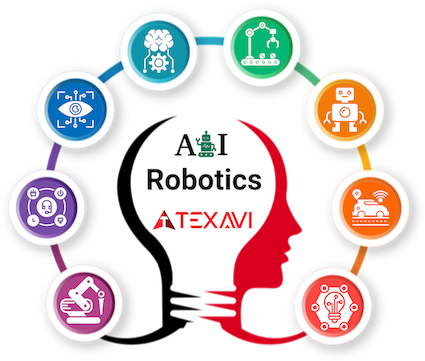
Autonomy, not just Automation

So now we have robots that are not just automatic but also autonomous, meaning they just don’t do complex and repetitive tasks but also learn constantly, make decisions, improve and improvise their work.Besides the hard-handling machines in heavy industries and destructive testing in military and defence, there are newer applications and use cases for this discipline. Increasingly robotic AI is making in-roads into the numerous real-world applications eg., surgical robots and clinical tests in healthcare to rovers in space exploration and beyond.
Check your AIQ (Artificial Intelligence Quotient), take the TEXAVI quiz on AI Robotics and the fundamental concepts and principles of artificial intelligence behind the autonomous and smart robots. The Texavi test is easy, quick and has only 15 MCQs, besides it is completely free too. Come on in, take the TEXAVI quiz and get tech-savvy with AI!

Related Articles

AI Is Not a Tool, It Is Cognitive Infrastructure!

There is a quiet ‘category error’ sitting at the centre of much of the AI conversation right now, and it is shaping decisions that will outlive the people making them.

We keep calling AI a tool.

Tools are picked up and put down. Tools sit in a drawer until needed. A hammer does not change what a wall is, what a house means, or how a neighbourhood feels. The framing is comfortable because it puts us in charge: we choose, we wield, we set down. I would argue, though, that it is the wrong frame. It is wrong in the way that calling electricity “a better candle” was wrong in 1890. The artefact is recognisable; the substrate it creates is not.

What we are actually building, and stitching into the daily fabric of work and life, is starting to behave more like cognitive infrastructure. Something that increasingly mediates how we perceive, decide, coordinate, and remember. You do not “use” infrastructure the way you use a tool. You live inside it. The question of who designs it, who maintains it, and who gets to question it becomes a different kind of question entirely. This distinction is not academic. It changes the strategy.

This article on artificial intelligence as a cognitive infrastructure framework is written by Rohit Mahadevu, AI and Digital Transformation Consultant at Texavi Innovative Solutions. Read on…

Touch, type and write – All in one!

Do you remember when you first started interacting with a device trying to learn something? Yes, You drew and wrote in your childhood, using slate and pencil. You slowly graduated into using keyboard and mouse, through which you can control the computer. But your experience underwent a significant change and the interaction and manipulation are not direct any more. In comes tap, slide and pinch…Touch phones and tablets, the which took interaction to a new level, eliminating the need for an external device such as mouse, keyboard and pen. But for those who need the best of all worlds, the Tablet PC convertible is here to stay…Now, type, touch,and write all your way! Read the post for a walk through of this transition with real life scenarios and our experiences!

The joy of surprise

‘Wow!’, a word that sums up the delightful experience and surprise expressed by users of very few products out there in the market. Apple has been consistently delivering what I call as ‘Wow experiences’ to its users from Macintosh, through to the recently-released iPad2. To be able to surprise your users you should not only focus on your products alone, but try and provide an OOBE (Out of the Box Experience) starting from pre-launch, to the point-of-purchase to the post-purchase opportunities. In the blog post, I give a few real life examples of how successful organization have been wooing and wowing their users, along with a few tips and tricks from my own experience. Read on to say wow…

Responses

Your email address will not be published. Required fields are marked *