
When Automation Meets Exceptions in AI

Why Edge Cases Determine Whether AI Systems Work in the Real World
Most automation demonstrations are built around the same assumption: the input is known, the process is predictable, and the expected output is clear.
Real operations rarely behave that neatly
- A registration arrives without the information the workflow expects.
- A communication needs to go out, but the situation has changed since the original instructions were written.
- Two systems contain different versions of the same information.
- A user request technically fits the rules but clearly needs human judgment.
- An AI-generated response is correct in isolation but inappropriate in context.
These situations are often described as edge cases. I have started to think that description is misleading.
Once an AI system moves from demonstration into everyday use, exceptions are no longer at the edge of the system—they become part of the system. That changes how automation should be designed. A workflow that performs perfectly when everything goes according to plan proves that the technology can execute the happy path. It tells us very little about whether the system can survive real operations. The more useful question is: what happens when something does not fit?
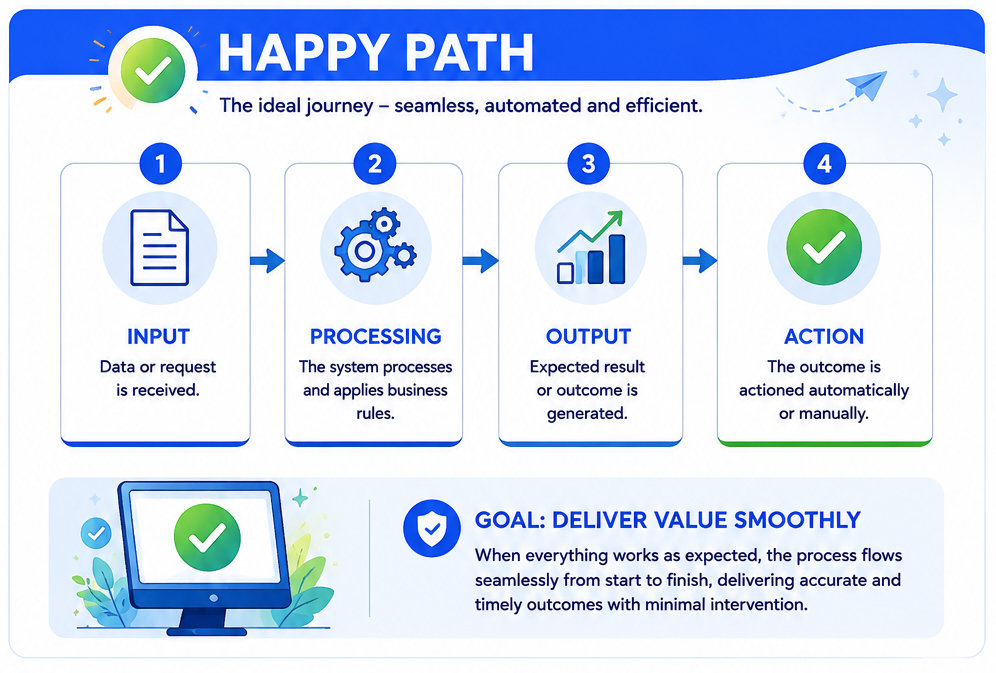
In AI-assisted workflows I have designed, the straightforward part has rarely been the most difficult. A defined input can be processed, categorized, summarized, or routed reasonably well. The problems begin when:
- The input is incomplete
- The context has changed
- The system encounters a situation that was never represented in the original instructions
At that point, improving the prompt is not always the answer. The system needs to know that it has reached the limits of what it should do.That distinction matters because traditional automation was largely deterministic. A rule was triggered, and an action followed. If the condition was known, the behavior could be predicted.
AI-assisted systems introduce judgment into that sequence. They can interpret language, infer intent, generate recommendations and deal with variation far better than traditional rules. That makes them more capable, but it also makes the boundary of acceptable behaviour less obvious.
A system can produce a plausible answer even when the underlying situation is ambiguous.That is one of the reasons exceptions can be difficult to detect. A traditional system often fails visibly. An AI system can fail fluently. The output may be well written. The classification may look reasonable. The recommendation may contain enough logic to appear defensible. What is missing may be a small piece of context that only becomes obvious to someone close to the situation.
During the design of AI-assisted operational workflows, I found that this changed the role of human review. Review was not simply there to correct bad AI outputs. It became a mechanism for dealing with situations the workflow itself could not confidently resolve.That sounds like a small distinction, but it changes the architecture considerably.
Instead of asking only what the AI should do, the design process needs to ask what the AI should do when it is uncertain.
- Should it continue?
- Should it ask for more information?
- Should it route the case somewhere else?
- Should it notify someone?
- Should it stop completely?
These questions are less exciting than choosing models or improving prompts, but they have a much greater effect on whether an automated system remains useful after deployment.One workflow I worked on involved recurring communication and engagement tasks. The routine cases were relatively easy to support with automation. Information arrived, the workflow processed it, and an appropriate next step could usually be prepared.
The interesting cases were the ones that looked routine but were not. A change in timing, an unusual request, conflicting information, or a stakeholder circumstance could make the normal next step inappropriate. The system did not necessarily know that. From its perspective, the input still resembled dozens of previous cases.
What improved the workflow was not making the AI more aggressive about reaching an answer. It was making the workflow better at recognizing when the normal path should no longer be trusted.That meant introducing clearer checks around missing information, unexpected changes, and situations where human judgment carried more value than automated speed. This is where I think many AI projects underestimate the engineering work involved.
Teams spend considerable time designing the main workflow:
Main Workflow: Input → Processing → Output → Action
Exception Path: Input → Unexpected Condition → Review / Escalation → Human Decision
In practice, the exception path often becomes the place where trust is either built or lost. A user is unlikely to remember the hundred occasions when an automated system handled an ordinary task correctly. They will remember the one occasion when circumstances were unusual, and the system continued as though nothing had changed.The quality of automation therefore depends partly on its ability to refuse automation.
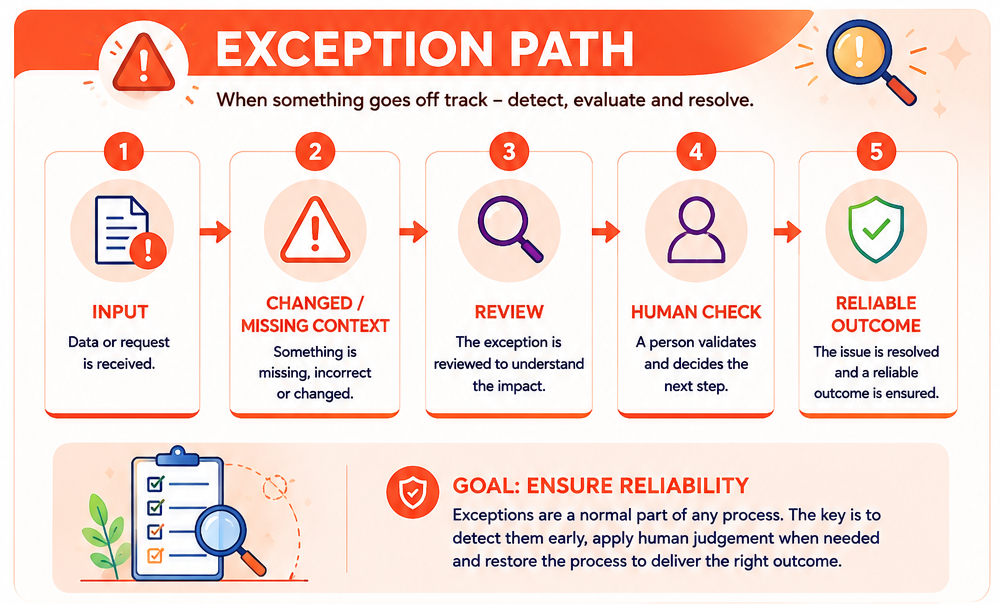
A mature system should not be designed to complete every task it encounters. It should be designed to understand which tasks fall inside its operating boundaries and what should happen when those boundaries are crossed.This does not require building an elaborate layer of controls around every workflow.Sometimes the most useful intervention is simple.
- A confidence threshold.
- A missing-data check.
- A comparison against previous state.
- A rule that certain categories always require review.
- A notification when a pattern changes unexpectedly.
- A clear person responsible for receiving that notification.
What matters is that these decisions are made intentionally.I have also found that exception handling becomes more important as automation succeeds.When a workflow is unreliable, people watch it closely. Every output is checked because nobody quite trusts the system yet.Once the system performs consistently, that attention declines. People begin relying on it. Manual checks disappear. The workflow becomes part of normal operations.Ironically, that is when exception design matters most.
The better the automation becomes at routine work, the less human attention remains available to notice the unusual.This creates an operational paradox: successful automation reduces supervision precisely when the remaining cases become more likely to require judgment.The answer is not to put people back into every step. That would remove much of the value of automation.The answer is to design systems that use human attention selectively.Routine work should remain routine. Exceptional work should become visible.That requires a different measure of automation quality.
Instead of asking only, “How many tasks did the system complete automatically?”, organizations should also ask, “How well did the system identify the tasks it should not complete automatically?”. The second number may tell us more about operational maturity than the first. This becomes even more important as AI systems move from producing outputs to taking actions.
An assistant that drafts a response creates limited exposure because someone can review the draft before anything happens. A system that sends the response, updates another platform, triggers a workflow, or initiates an external action has considerably less room for unnoticed error. As autonomy increases, exception handling stops being a supporting feature. It becomes part of the core system design.
I do not think this means organizations should become more cautious about automation. It means they should become more precise. The objective is not maximum automation.
It is reliable automation.
Those are not the same thing.
The most useful AI systems I have worked with were not the systems that attempted to handle everything. They were the ones where the boundary between routine execution and human judgment became clearer over time. Every exception taught us something about that boundary.Sometimes the workflow needed additional context.Sometimes a rule needed changing. Sometimes the system needed a new escalation path.
And sometimes the correct improvement was simply to recognize that a particular decision should remain with a person.That is why I increasingly see exceptions as part of the design process rather than evidence that the design failed.
The happy path tells us whether an AI system can work.
The exception path tells us whether it can keep working when the real world arrives.
Responses