
Governance Infrastructure: The Missing Layer of AI Transformation

Why Organisations Are Scaling AI Capability Faster Than Accountability
Organisations are building AI capabilities at a pace that their accountability structures cannot match. Assistants, agents, automation systems, and decision-support tools are being deployed across operations with genuine speed. The organisational infrastructure needed to oversee those systems responsibly is being built far more slowly, and often not at all.
This article argues that governance should not be understood primarily as compliance, policy, or regulation. It should be understood as infrastructure: the accountability mechanisms, oversight structures, escalation pathways, review processes, and feedback loops that allow AI-enabled systems to operate predictably and sustainably at scale.
Without governance infrastructure, organisations simply cannot assume regulatory risks. They are building operational systems that no one is truly accountable for.
Here is an interesting article from Rohit Mahadevu, AI and Digital Transformation Consultant at Texavi Innovative Solutions. Read on…
Opening Observation
When something goes wrong with an AI-assisted system, the first question most organisations ask is technical.
- What did the system do?
- What output did it produce?
- Why did it respond that way?
- The more important question is usually asked later.
- Who was responsible for that decision?
- What was the process for reviewing it?
- What happens now?
For many organisations, there is no satisfying answer. People are not negligent; the accountability structure was poorly designed.
The system was implemented.
The capability was built.
The oversight was assumed.
This assumption indicates the point at which organisations are most vulnerable.
The Capability–Accountability Gap
AI capability scales in a way that human accountability structures do not.
A workflow automation system can process thousands of outputs per day. A content generation tool can produce communications at a volume no team could review individually. An AI-assisted decision-support system can influence choices across an organisation faster than any governance process can track.
Capability, by its nature, expands. Accountability does not expand automatically. It has to be designed.
Most organisations understand this concept as a principle. Fewer have acted on it in practice. The gap between AI systems’ capabilities and organisations’ oversight is widening, not due to negligence, but because governance design has not kept up with capability design.
This is the central problem. And it is not primarily a technology problem.
Most organisations can explain what their AI systems do. Far fewer can explain who is accountable when those systems are wrong.
The capability–accountability gap is not always visible when things are working. It becomes visible at moments of failure: when an automated communication is sent incorrectly, when a recommendation leads to a poor outcome, when a system behaves in a way that no one anticipated, and no one is clear whose responsibility it is to respond.
By that point, the absence of governance infrastructure is no longer theoretical. It is operational.
Why Governance Is Often Misunderstood
The word ‘governance‘ triggers a particular set of associations in most organisations: • Policies • Compliance frameworks • Audit requirements • Legal obligations • Risk registers
These things matter. But they are not governance infrastructure.
These outputs result from a governance process that, often, has not yet been established for AI systems.
A policy document on AI use is not the same as a system that ensures it.
A risk register that identifies AI-related risks is not the same as an organisation that has clarity on who owns those risks operationally.
Governance is frequently mistaken for documentation.
The organisation creates a policy, fulfils its requirements, and moves on.
What it does not produce is an operational structure: the people, processes, review checkpoints, and escalation mechanisms that make accountability real rather than written.
Governance documents describe what should happen.
Governance infrastructure determines what actually happens.
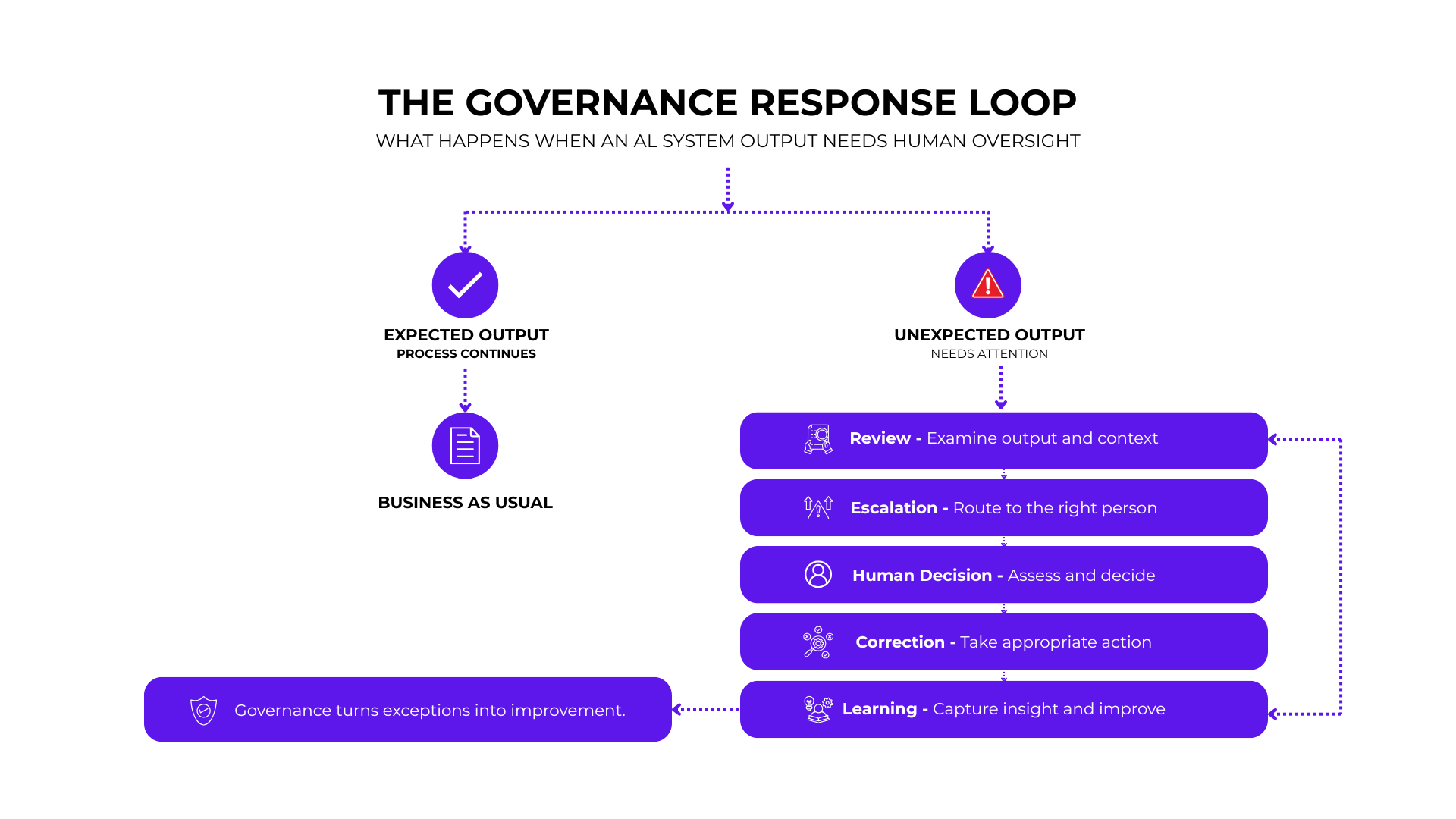
This distinction matters enormously in practice. When an AI workflow produces an unexpected output, the governance document may specify that a human should review it.
But without infrastructure, a designated reviewer, a defined process, and a clear escalation path if the reviewer disagrees with the system, the policy is aspirational rather than operational.
Organisations that understand these issues are beginning to approach governance differently.
Governance should not be viewed merely as a compliance layer to satisfy but rather as an operational architecture that needs to be designed.
Introducing Governance Infrastructure
Governance Infrastructure is the collection of accountability mechanisms, oversight structures, escalation pathways, review processes, feedback loops, and decision frameworks that allow AI-enabled systems to operate responsibly, predictably, and sustainably at scale.
It is not a framework.
It is a lens.
The distinction is deliberate.
Frameworks invite organisations to map themselves against a maturation model and move on.
The lens invites a different question: When I look at any AI-enabled system in this organisation, can I see the governance infrastructure that supports it?
That question has three dimensions. Oversight Is there a person, team, or process responsible for monitoring this system’s outputs?
Not occasionally, consistently.
Accountability When this system makes an error or produces an unexpected result, is it clear who owns the response?
Not in principle, operationally.
Escalation When something falls outside the expected parameters of this system, an unusual output, an edge case, or a sensitive situation, is there a defined path for it to reach a human decision-maker?
Most organisations that have deployed AI systems can partially answer the first question.
Fewer can answer the second clearly.
The third is often entirely absent.
Governance infrastructure is what makes all three answers concrete, not theoretical.
What Governance Infrastructure Looks Like in Practice
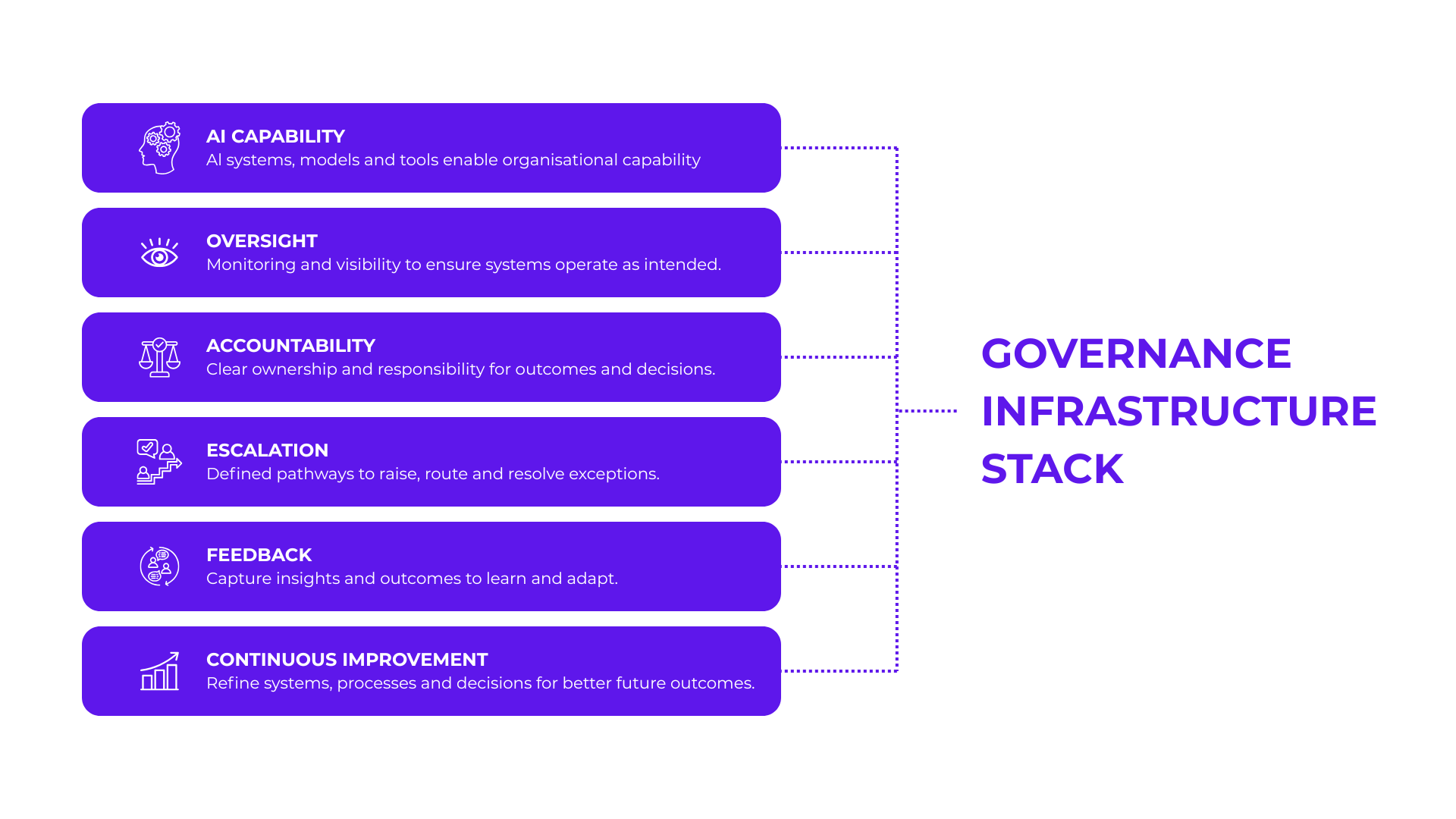 In practice, governance infrastructure is less dramatic than the term implies.
It is not a control room or a sophisticated monitoring platform.
It is, at its most basic, a set of designed operational structures.
A workflow automation system that generates outbound communications should have a designated review stage, not for every output, but for categories of output that carry higher consequence.
Someone should own that review.
That ownership should be explicit, not assumed.
An AI-assisted decision-support tool should have a defined exception pathway.
When the system recommends something that a practitioner questions, there should be a clear process for escalating that question, not just the option to ignore the recommendation.
A content system that operates at volume should have feedback loops that surface patterns of error or deviation, not just individual incidents.
Over time, the organisation should know whether its system is performing according to accepted parameters.
A governance failure is rarely a single event.
It is usually the cumulative result of processes that were never designed. These structures are not expensive to build.
They are, however, easy to skip when the priority is deployment speed and the reward structure favours capability over accountability.
Lessons from AI-Assisted Operations
 Working with AI-assisted systems across different operational contexts has surfaced a consistent pattern.
The governance problems that emerge are rarely unexpected.
These governance problems naturally result from accountability structures that do not extend to AI-enabled parts of the organisation.
When an AI system is embedded into a workflow, there is typically a period of genuine optimism.
The system performs well.
The output is useful.
Adoption increases.
The process feels efficient.
The governance problems arrive quietly.
An output falls outside expected parameters, and no one is certain whose responsibility it is to correct it.
A pattern of minor errors accumulates without being identified as a pattern.
A sensitive message is sent without the review that was intended because the review was assumed, not enforced.
None of these failures are catastrophic in isolation.
Collectively, they erode something that is difficult to rebuild: the confidence of the people working within and alongside the system.
System performance alone does not build trust in an AI-enabled system.
Trust is built when an organisation demonstrates that they know how to effectively respond when the system fails.
This is where governance infrastructure becomes strategic rather than merely operational.
An organisation that can demonstrate clear accountability, visible oversight, and consistent escalation processes does more than just manage risks.
By fostering trust among both operators and the people they serve, AI-enabled systems can thrive.
Common Governance Failures
Several patterns have consistently emerged among organisations that scaled their AI capabilities without making comparable governance investments.
The Invisible Handoff An AI system supports or partially makes a decision, but no one clearly assigns accountability for it.
The system acted.
A human approved.
But no one is distinctly responsible for the outcome.
The Unenforced Checkpoint A governance policy specifies that human review should occur at a particular stage.
In practice, the review is skipped under volume pressure, and the system is trusted to be accurate.
The checkpoint exists on paper and nowhere else.
The Absent Escalation Path An AI system surfaces an output that a practitioner finds questionable. There is no defined process for escalating that concern. The practitioner either acts on the output despite their reservations or disregards it without any record of the exception.
The Unexamined Drift An AI system performs within acceptable parameters at deployment.
Over time, the parameters of acceptable performance are never reassessed.
The system drifts not suddenly but gradually, and the drift goes unexamined because no one is structurally responsible for examining it.
The most expensive governance failure is not the one that makes headlines.
It is the one that quietly degrades the system; no one is watching.
Each of these failures is preventable.
None of them requires sophisticated technology to address.
They require operational design: the deliberate construction of accountability mechanisms before they are needed, not after they are missed.
Future Implications
As AI systems become more capable, not just at processing tasks but at exercising something that resembles judgement, the governance question becomes more complex.
An AI assistant that drafts a document is accountable in a straightforward way.
An AI agent that takes actions, makes decisions, and interacts with external systems operates in a space where accountability becomes genuinely difficult to attribute.
This is the direction in which AI deployment is moving.
Organisations that have not built governance infrastructure for their current systems will discover themselves significantly underprepared for agents.
The competitive dimension is also often overlooked.
Governance capability may become a meaningful differentiator, not in the regulatory sense, but in the operational sense.
Organisations that can demonstrate that their AI-enabled systems are consistently overseen, that accountability is clear, and that errors are handled predictably will be better positioned to scale those systems into higher-stakes contexts.
Governance capability is not just a safeguard.
For organisations that build it well, it becomes the basis for doing more, not less.
The organisations that are building governance infrastructure are not slowing their AI adoption.
They are fostering an environment that allows for broader and more confident deployment of AI in high-stakes areas.
Conclusion
The argument here is not that AI capability should slow down to allow governance to catch up.
The argument is that governance should be understood as a form of infrastructure, something that is designed in parallel with capability, not added afterwards when problems emerge.
Infrastructure, by definition, is what makes everything else possible. Technical infrastructure allows systems to operate.
Operational infrastructure allows processes to function.
Governance infrastructure enables the responsible scaling of AI-enabled systems, ensuring oversight, corrections, trust, and extensions in increasingly vital areas of an organisation’s operations.
The gap between what AI systems can do and what organisations can currently account for is not an inevitable feature of AI adoption.
It is a design choice.
Organisations are choosing, implicitly or explicitly, to build capability before accountability.
Those who treat governance as a design choice rather than a retrofitting process will manage their AI deployments more responsibly.
They will manage them more effectively.
The most trusted systems are those that openly disclose who bears responsibility when issues arise.
That is not a compliance insight.
It is an operational one.
Responses