
From Prompts to Persistent Systems – The Evolution of AI

The future of AI is not about better conversations, it is about better operational design!
A few months into rolling out AI-assisted workflows across a community programme, I noticed something odd. The people using AI most successfully weren’t the ones asking the cleverest questions. They were the ones who had stopped asking questions altogether.
They had built something instead. A workflow that checked for updates on its own. The process flagged any issues that required human attention. A system that remembered what had happened last week without being told again. Everyone else was still typing, still prompting, and still starting from a blank box every morning.This article by Rohit Mahadevu, AI and Digital Transformation Consultant at Texavi Innovative Solutions, puts the focus on persistent systems as the future of AI.
Why Prompt-Based AI Doesn’t Scale
Most organisations still treat AI as a conversation. Someone asks a question, receives an answer, copies it into a document, and closes the tab. Tomorrow, the same question. Tomorrow, someone who has forgotten the previous answer will ask the same question again, but with a slight rewording. Again, the question will Someone who has forgotten the previous answer will slightly reword the question again. by someone who has forgotten the previous answer.
This works well enough for one-off tasks. The system fails when AI is expected to assist with ongoing tasks.
The problem isn’t the quality of the answers. Modern models are adept at answering questions. The problem is that a conversation has no memory of itself once it ends, no awareness of what changed since the last time someone asked, and no way of acting unless a person shows up to type the next instruction.
I’ve watched teams invest real effort into prompt design, carefully worded instructions, well-structured context, and useful examples and still end up doing the same manual work every week. The prompt improved. The pattern of effort didn’t. Someone still had to remember to open the tool, still had to paste in the latest data, and still had to notice that something needed to be reviewed.
That repetition is not a training problem. It’s a design problem. A beneficial prompt produces a beneficial single response. It does not produce a system that keeps working once you stop typing.
It also creates a quieter cost that’s easy to miss: knowledge that lives only in the conversation. If useful judgements—such as what counts as urgent, what to ignore, and who to notify—exist only within an individual’s prompt history, they are lost to the organisation as soon as that person stops typing those prompts. Nothing was actually captured. Nothing was actually built.
The Shift Towards Persistent Systems
The organisations that are deriving real value from AI have quietly stopped viewing it as merely a tool for conversation and have begun to see it as a platform for building solutions. I think of these as persistent AI systems: AI capability that continues operating between conversations rather than only during them. Instead of a person triggering every step, the system itself does the following: • monitors information as it changes • remembers relevant context from previous cycles • compares new inputs against what came before • escalates to a person when something needs judgement • It improves its outputs by learning from previous successes. • It notifies the appropriate person at the optimal time. None of these tasks require exotic technology. It requires designing AI as part of an ongoing process rather than as a single request-and-response exchange. The shift is not about smarter answers. It’s about designing something that doesn’t need to be asked the same question twice. This approach represents a different type of work compared to prompt engineering, as it focuses on a different question. Prompt engineering asks, ‘How do I phrase this so the model gives me the right answer right now?‘ Persistent system design asks, ‘How do I structure the system so the right thing happens without me having to ask at all?‘
Designing AI That Keeps Working
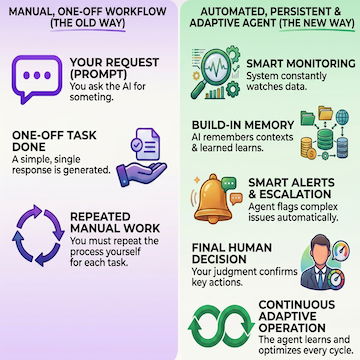
Building a persistent system means thinking less about the instruction and more about the architecture around it: what triggers the system, what it checks, what it holds onto, and where a human needs to step in.
In practice, that architecture tends to rest on four things working together: a workflow that orchestrates the steps in order, contextual awareness so the system knows what it’s looking at and why, a way of engaging adaptively rather than following one rigid script, and clear points where oversight sits with a person rather than the model. I’ve come to think of this combination, orchestration, context, adaptive engagement, and human oversight as the backbone of any AI system meant to run continuously rather than answer once.
Memory is the part people underestimate. Without memory, every interaction starts over, and the system is only as effective as the prompt. With even a modest memory layer (a record of previous decisions, prior states, and past exceptions), the system starts behaving less like a tool and more like a colleague who was in the room last time.
Monitoring is relevant for the same reason. A system that only acts when prompted is still, fundamentally, a conversation. A system that checks conditions on a schedule or reacts when something changes has crossed into genuinely different territory. This stage is usually the point at which organisations feel AI has become operational rather than experimental.
Escalation is where I’ve seen the most resistance and the most necessary discipline. Persistence does not mean removing people. It means being precise about which decisions the system can carry and which ones it should hand back. In every workflow I’ve built, the most important design decision was never the prompt. It was the escalation boundary: the line marking where the system stops and a person takes over. If that line is misplaced, it can either overwhelm people with noise or allow the system to make decisions it shouldn’t be making alone.
What Changed in AI Implementations
Early in my own AI-assisted workflow projects, the challenge I expected was prompt quality. The challenge I actually faced was reliability after deployment. A workflow that worked well in testing would quietly stop delivering value a few weeks later, not because the prompts had degraded, but because the system lacked a check for changing conditions. Inputs shifted, context aged, and the workflow kept producing technically correct outputs to a question that was no longer the right one to ask. The solution wasn’t a better prompt. It was building in a step that periodically re-checked the assumptions the workflow depended on.
The second shift occurred when I began to treat monitoring and escalation as essential components of the design, rather than as afterthoughts added only after a problem arose. In an operational workflow I built for tracking recurring community engagement tasks, the useful part wasn’t the AI-generated summary. The notification that alerted the appropriate person when something deviated from the expected pattern, along with the review step that allowed them to make the final decision, were the most valuable aspects. Improving that escalation logic did more for the reliability of the whole system than any amount of rewording the underlying prompts.
Both experiences taught me the same lesson from different angles: the effort that actually compounds is spent on the structure around the AI, not the instruction given to it. The moment users employ prompts, they immediately begin to consume them. the moment they’re used. Structure keeps paying back long after the person who built it has moved on to something else.
Looking Ahead
Prompt engineering will remain a useful skill. Someone still needs to know how to phrase an instruction clearly and give a model the right context. But it is a component skill, not an organisational strategy.
The organisations that get ahead over the coming years won’t be the ones with the best prompts. They’ll be the ones who stopped asking AI to answer the same question every day and instead built something that kept answering it on its own: checking, remembering, escalating, and improving, with a person still firmly in charge of the decisions that matter.
The real shift isn’t conversational intelligence. It’s operational persistence. Organisations that design for that now will spend less time repeating themselves and more time deciding what to do with the time they have left.
Responses