
The Forgotten Infrastructure of Digital Transformation

Why Technology Initiatives Fail When Organisations Invest in Tools Faster Than People
Technology is the foundation for most digital transformation programmes. Organisations plan platform migrations, procure software, deploy automation, and measure success based on implementation velocity. What they less frequently account for is the human system that determines whether any of that technology creates lasting value.
This article introduces the concept of human infrastructure: the capabilities, trust networks, learning systems, relationships, and adaptive behaviours that allow technology investments to produce meaningful outcomes. It argues that most transformation failures are not technical in origin. They occur because organisations build systems for people who are not yet ready to use them and measure adoption while overlooking whether behaviour has changed.
This problem is not new. But it is becoming more consequential. As AI systems grow more capable, they expose and amplify gaps in organisational learning faster than any previous technology. Understanding human infrastructure and investing in it deliberately is no longer a secondary consideration. This condition is essential for successful transformation.
Read on…here is an interesting article from Rohit Mahadevu, AI and Digital Transformation Consultant at Texavi Innovative Solutions.
An Observation Before the Argument
Several years into working at the intersection of AI implementation, digital workflows, and community-based technology adoption, I noticed a consistent pattern. Organisations that struggled with transformation usually struggled for other reasons than technology failure. Their platforms worked. Their integrations held. Their dashboards populated on schedule. What had not changed was how people worked, what decisions they made, and what they trusted. The systems were live. The organisation had not been transformed.
This experience repeated itself across contexts and sectors with enough consistency that it stopped feeling like isolated project failures and started looking like a structural problem, one that the industry had not quite named clearly enough. And as AI enters more organisations, I’ve seen the pattern accelerate. The gap between what technology can do and what organisations actually do with it is not closing. Often, it is widening.
The Technology Bias in Digital Transformation
Digital transformation carries an implicit bias. The word ‘digital’ directs attention toward systems, software, and infrastructure. The word ‘transformation’ is borrowed and rarely examined. Organisations speak of transformation, but it frequently means implementation.
The result is a predictable pattern. Technology is procured before capability is developed. Deployment precedes readiness. The measurement focuses on adoption rates rather than behavioural changes. And when outcomes fall short, the instinct is often to revisit the technology rather than examine the supporting infrastructure.
Organisations primarily succeed or fail in digital transformations due to people and process issues rather than faulty technology. They fail because the systems arrived before the people were ready for them.
Why Transformation Often Stalls
People usually accept technology itself. What they resist is uncertainty—the uncertainty of performing less competently than before, whether new systems will make their work harder, and whether their existing knowledge still has value.
Organisations that treat such behaviour as resistance respond with campaigns and mandatory training. Organisations that treat it as a confidence deficit ask a more useful question: What conditions would make adoption feel like an improvement rather than an imposition?
A second reason transformation stalls is that adoption is mistaken for change. A team can submit forms in a new platform while continuing to make every meaningful decision exactly as they did before. Adoption is measurable. Transformation is not always visible in the same data.
A third reason is that knowledge does not travel with technology. A system’s contextual understanding, its limits, and how to adapt it to local conditions must be built separately and continuously. Most organisations treat the issue as a one-time onboarding problem. It is an ongoing infrastructure requirement.
With AI systems, the problem deepens: outputs vary across contexts, and organisations that declare a deployment complete after initial adoption often discover they have measured access rather than capability.
Introducing the Idea of Human Infrastructure
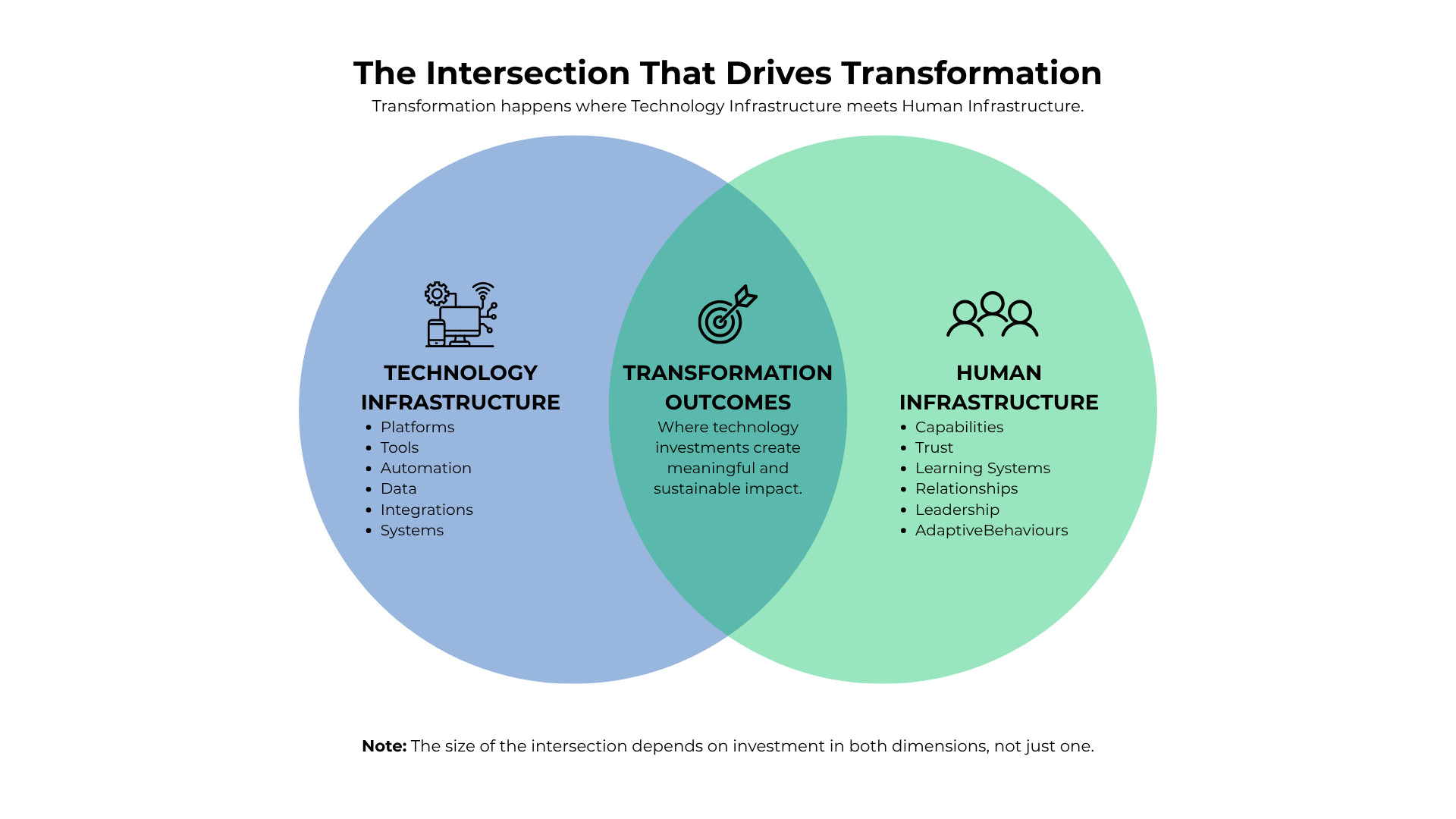
Human infrastructure is a collection of capabilities, relationships, trust networks, learning mechanisms, knowledge systems, leadership behaviours, and adaptive capacities that allow technological investments to produce meaningful outcomes.
It is not a training programme.
It is not a change management plan.
It is not a communications strategy.
Those things address specific moments in a technology deployment. Human infrastructure is the persistent, underlying system that makes an organisation capable of working with technology not just once, but continuously, as systems evolve and demands on them change.
Change management asks:
How do we obtain people through this transition?
Human Infrastructure asks:
What must this organisation become, and how will it maintain that capability?
What makes human infrastructure particularly important now is the pace at which the technology side of this equation is accelerating. Platforms update. AI capabilities expand. Automation extends into processes that were manual a year ago.
Technology does not wait for organisations to integrate what they already have before offering more. The gap between what tech can do and what an org can do with it is real and measurable.
And without deliberate investment in human infrastructure, it widens automatically.
Technological capability is growing faster than organisational learning capacity. The effectiveness of human infrastructure determines whether the gap between technological capability and organisational learning capacity closes or widens.
Human infrastructure is what transforms a technology investment into an organisational capability.
The Role of Capability, Trust, and Learning
Capability
Capability is not equivalent to training completion. It is the ability to apply knowledge in context to identify when a system is producing unreliable outputs, to adapt workflows when circumstances change, and to interrogate an output rather than simply receive it.
Earlier generations of software were predictable: Right inputs, consistent outputs.
AI systems produce outputs that are probabilistic, context-dependent, and sometimes plausible-sounding but wrong.
Using them well requires evaluation skills, not just operational ones. That capability develops through use and reflection in conditions where making mistakes is recoverable. Organisations that rush deployments without creating those conditions are deferring capability-building costs while accumulating adoptions without value.
Technology is often deployed in months. Capability development takes years.
Trust
With AI, trust requires calibration rather than confidence.
People must learn when to trust a system and when to doubt it; this calibration process is not intuitive. It develops through experience in environments where questioning an output is treated as beneficial judgement rather than incompetence.
Skip that step, and organisations create overreliance or avoidance. Both undermine the investment.
Most organisations train people to use AI systems. Fewer invest in helping people understand when not to trust them.
Learning Systems
The organisations that support transformation treat learning as a structural requirement, not a periodic event.
They build systems through which knowledge circulates continuously… • Communities of practice • Peer networks • Documented experiences • Feedback loops
With AI, such knowledge matters more. When a team discovers that a tool produces unreliable outputs in a specific context, that discovery has operational value for every other team using the same system.
Static training cannot capture these dynamics.
Learning infrastructure has to.
What Organisations Consistently Underestimate
The first is the cost of adaptation. Every new system requires users to revise their mental models of how work is done, a cognitive cost that is invisible in project plans but compounds when multiple programmes run simultaneously.
The second is the fragility of informal knowledge. When technology changes and informal networks are not consciously rebuilt around new systems, capability regresses in ways that metrics usually miss.
The third, which AI is making increasingly visible, is the governance cost of intelligent systems.When technology only executed instructions, judgement stayed with people. When it begins to generate recommendations and automate decisions, the question of who understands what it is doing and who is responsible for the outcomes becomes urgent.
The next division in digital transformation will not be between organisations with AI and those without it. The next division in the digital transformation will be between organisations whose people can question, adapt, and govern AI systems and those who can only operate them.
Lessons from Real-World Transformation Efforts
Where peer learning was deliberately built into adoption, where experienced users taught others, questions were normalised, and teams shared what they discovered, abilities grew faster and more evenly.
The social architecture of learning is not a soft consideration. It is a structural one.
With AI systems, this lesson intensifies because outputs are contextual and variable. One team’s insights about effectively using a tool are not automatically visible to others.
The organisations that move fastest with AI are often those that invested the earliest in structures that allowed learning to accumulate across teams.
Building Human Infrastructure Intentionally
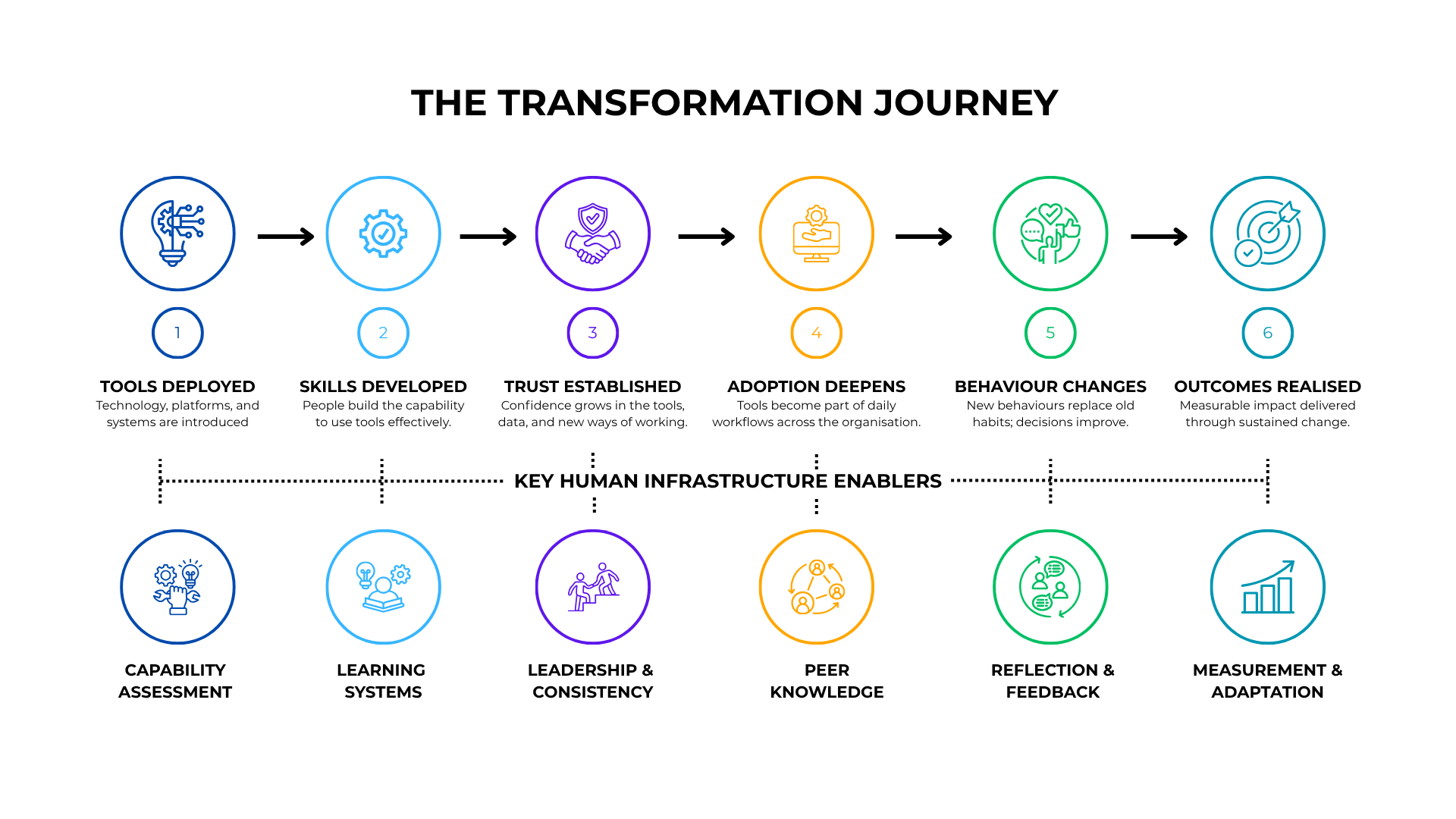
In practice, this approach involves assessing capabilities before deployment instead of waiting for problems to surface after adoption.
It means building learning environments that persist beyond implementation: • Peer networks • Documented experience • Structured reflection
For AI systems, technology is constantly evolving, and capabilities must evolve accordingly.
It also means appropriate leadership behaviour during the transition: • Modelling learning • Communicating honestly about uncertainty • Creating conditions in which developing new skills is not encouraged
And it means measuring what matters rather than what is measurable. Adoption rates do not indicate the organization’s increased capabilities, the spread of knowledge, or the use of technology for improvement.
Tracking capability, not just usage, is itself an act of building the infrastructure that sustains transformation.
From Tool Competence to Judgement Competence
There is a distinction that the industry has not yet named cleanly enough, and it sits at the centre of why human infrastructure matters more now than it did a decade ago.
For most of the history of enterprise technology, the primary question was: Can people operate the system?
This question is tool competence.
AI-era technology raises a different question- can people make sound decisions while working with the technology?
This is judgement competence.
It develops through experience, reflection, and environments that encourage questioning rather than blind acceptance.
Most organisations invest heavily in tool expertise.
Only a few have built the conditions required for judgement competence to develop at scale.
This is the gap that human infrastructure is intended to address.
The next competitive advantage might be something other than access to better systems. It may be the ability to develop better judgement about when, how, and whether to trust them.
Future Implications
Every form of AI-assisted work requires judgement competence, not just operational competence.
Decision support requires humans who can determine when to trust an output and when to override it.
Intelligent content generation requires users who can evaluate quality rather than simply consume it.
These capabilities do not develop with access to technology.
They develop from learning environments designed for reflection, from accumulated experience, and from feedback structures that help people understand when their judgement was right and when it was not.
AI requires more human judgement. It requires better human judgement, which is applied at different points in the process and developed under conditions that most organisations have not yet created.
There is also a question of equity.
Transformation that builds capability unevenly creates fragmentation rather than progress.
Human infrastructure invested broadly produces more durable outcomes than human infrastructure invested narrowly.
Conclusion
The infrastructure that makes digital transformation succeed is often different from the infrastructure that receives the most investment.
Human infrastructure explains that gap.
Human infrastructure encompasses the capabilities, trust networks, learning systems, and adaptive behaviours that enable technology investments to fulfil their intended purpose.
Most organisations rebuilt the technical side of the transformation with precision.
The human side receives a fraction of that attention and a fraction of the budget.
The pace at which AI and automation are entering organisational environments outpaces the rate at which most organisations are developing their human capabilities to work well with them.
Human infrastructure is not a secondary investment.
It is not what you build after the technology is working.
It is what determines whether the technology ever works in the way the organisation intended.
Technology provides organisations with new opportunities.
Human infrastructure determines whether those possibilities become reality.
Transformation that invests in technology without investing equally in people does not slow the rate of change. It creates an organisation that changes the appearance of work without altering its substance.
Responses