
Building AI-Assisted Community Operations: From Tools to Workflows

Most organisations have adopted AI tools. Far fewer have successfully integrated them into the operational workflows that actually drive their work. That gap is not a technology problem. It is a design problem, compounded by a consistent underestimation of how much needs to change around a tool for it to function effectively.
This article shares five practical lessons drawn from experience designing and operating AI-assisted workflows across community engagement, outreach, event coordination, and communication systems. It also introduces the concept of coordination infrastructure: the idea that AI’s most durable value in operational environments often lies not in content generation but in reducing the coordination overhead that quietly consumes organisational capacity.
The focus throughout is on what actually happens when AI moves beyond experimentation. Check out the interesting article written by Rohit Mahadevu, AI and Digital Transformation Consultant at Texavi Innovative Solutions.
The Difference Between Access and Integration
There is a meaningful difference between having access to an AI tool and having an AI-enabled operation. The first is a procurement decision. The second is a design challenge that involves workflows, communication patterns, and human behaviour, as well as the sometimes-uncomfortable discovery that the systems surrounding a tool matter more than the tool itself.
Many organisations have discovered these truths the hard way. A team installs a writing assistant and finds that the bottleneck was never writing. It was approval, routing, and the fact that nobody agreed on tone. A coordinator deploys a scheduling tool and discovers the calendar is not the problem. The problem is that nobody has clarity on who makes the decisions the calendar is supposed to reflect.
Most community leaders think they have a communication problem. More often, they have a coordination problem dressed up as one. Organisations that effectively use AI typically engage in the less glamourous task of understanding their workflows before integrating automation. That work rarely makes it into conference presentations.
Broken Workflows Cannot Be Automated
The most common mistake in AI adoption is dropping a tool in an existing process without examining it first. The assumption is that the tool will absorb the friction, automate the slow parts, and leave everything else intact. What usually happens instead is that the tool reveals exactly where the process was already fragile.
In community operations, communications rarely flow through a single channel. There are emails, messaging apps, spreadsheets, shared documents, verbal updates, and the institutional memory held by whoever has been doing the job longest. An AI communication tool works well for the parts it can see but produces inconsistent outputs for the parts it cannot. The result is faster-produced communication that requires significant manual correction.
The solution does not involve using a better tool. It is mapping the workflow first: understanding what information flows where, who makes which decisions, and where the real bottlenecks are. This process does not involve AI at all. But it is the work that determines whether any AI component deployed afterwards will add value or add noise.
Disconnected systems make this problem worse. Multiple platforms that were never designed to work together dominate most operational environments. An AI tool in one of these systems generates outputs that require manual transfer to the others. If someone doesn’t explicitly own that step, it becomes informal, inconsistent, and eventually a source of errors that no one can trace.
“AI does not improve a broken operational environment. It makes the breakage more visible.“
Prompt Design Is Operational Design
In most deployments, prompts are treated as a user interface concern: something you adjust when the output is not quite right. This approach underestimates what prompts actually are. A prompt is an operational specification. It determines tone, structure, scope, and the degree to which a human reviewer will need to intervene in the result.
Using the same AI tool without shared prompt standards among multiple users leads to unpredictable outputs, resulting in significant operational challenges. Different team members produce communications with different tones. Summaries vary in length and depth. Content generated for one audience is repurposed for another without the adjustment it needs. The tool works. The system does not.
Prompt architecture – recyclable, organised templates that include operational contexts, tone guidelines, and output formatting – is one of the most important design choices for AI-assisted workflows. Organisations tend to treat it as something individuals figure out for themselves, which means every user figures it out differently.
In community engagement work, the choice of prompt matters in ways that are difficult to recover from. Outreach communication implicitly conveys a relationship between the organization and the individuals it targets. A message that is technically accurate but tonally off can undermine trust that took months to build. Getting the prompt right is not a refinement. It is the work.
Practical note: Shared prompt libraries, maintained and reviewed, are as important as any other operational documentation. Treat them accordingly.
Automation Requires Accountability
Automation removes the need for human attention at specific points in a process. The risk is that it also removes human attention from those points, including attention that was serving a function the automation cannot replicate.
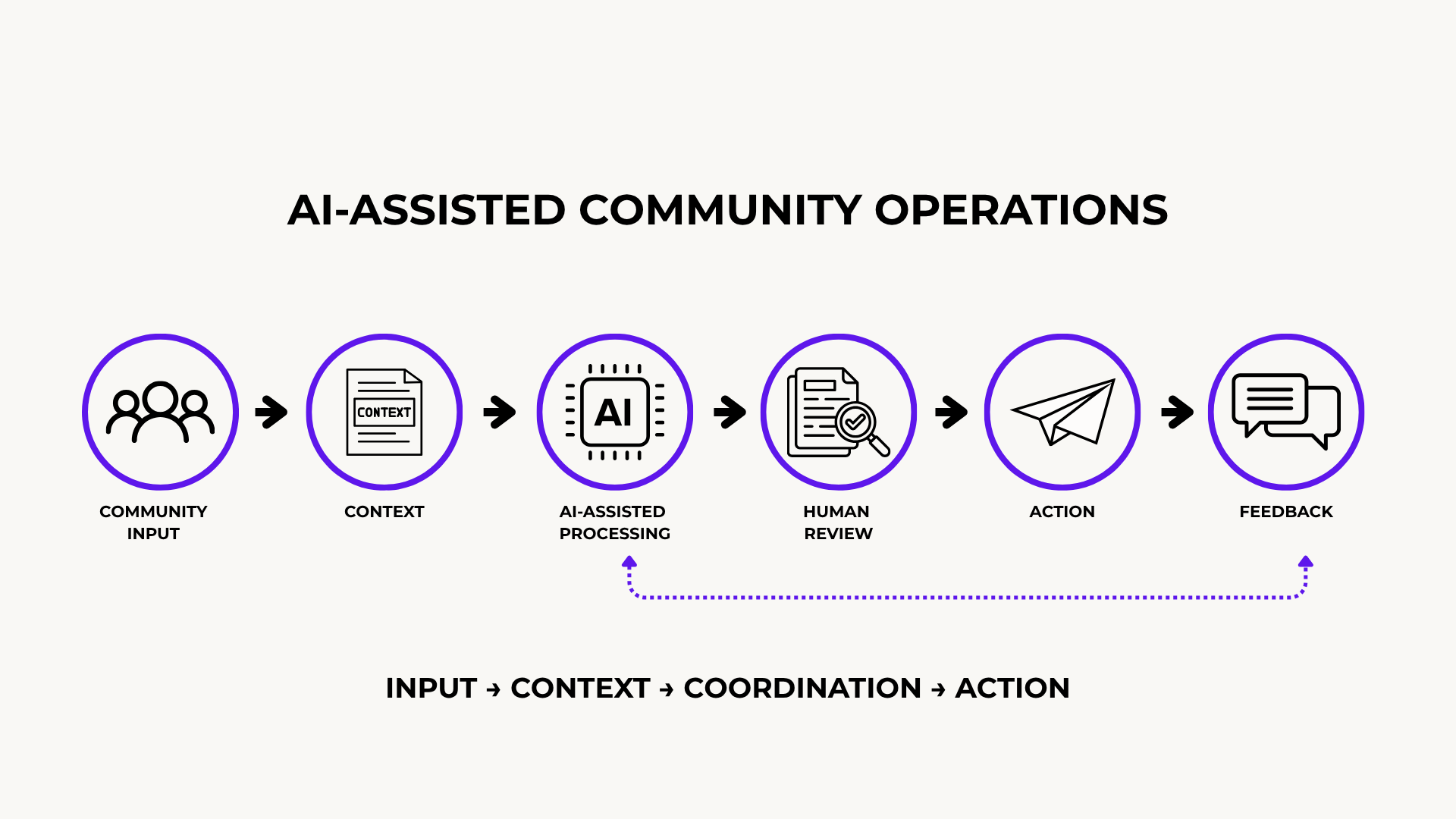
Automated communication sequences are a recurring example. The sequence is designed, tested, and deployed. It runs. Responses arrive. The system works efficiently until something unexpected happens: a participant replies with a concern that does not fit the logic, a message reaches the wrong segment, or a tone appropriate six months ago is now discordant with something that has changed in the community. Without an explicit process for reviewing outputs and handling escalations, these failures propagate without anyone noticing.
Many AI deployments fail long before the technology becomes the issue. They fail because nobody decided who was responsible when the system produced something wrong.
Escalation paths are particularly important and frequently absent. An automated system without a mechanism to recognise its competency limits will handle situations that it was not designed for in ways that range from unhelpful to damaging. Building escalation in from the start is not a concession to the technology’s limitations. It is a basic condition of deploying it responsibly.
“The governance question is not whether to automate. It is where human review sits and who is accountable for what the system produces.“
Context Creates Utility
The outputs of AI tools are only as useful as the context available for the system generating them. A capable AI with poor context produces generically adequate outputs that require substantial editing to become operationally useful. A less capable AI with well-designed context can produce outputs that are immediately useful. Context design delivers more value than tool selection. This is probably the least understood thing about AI deployment in practice.
In community operations, context has dimensions that are easy to miss. There is audience context: who is this person? What’s their history with the organisation? What level of familiarity should the communication assume? There is operational context: what has already been communicated, and what does this person need to do next? And there is organisational context: what tone and commitments does the organisation want this exchange to reflect?
Information is usually sufficient. Community systems often struggle to transform information into the appropriate output for the appropriate individual at the appropriate time.
None of this contextual information is automatically accessible to an AI tool. This design work must be intentionally incorporated through structured data retrieval, prompt templates that encode relevant variables, and integration with existing records in the environment. This design work is invisible in the output but responsible for most of its quality.
Trust Develops More Slowly Than Capability
AI capabilities improve faster than the organisational trust required to use them effectively. Organisations that rush to deploy capabilities that their teams do not trust create systems that are technically functional but practically useless.
Trust in an AI-assisted system works differently to trust in a colleague. With a colleague, trust builds through repeated interaction and demonstrated judgement. With an AI system, it builds through predictability: repeated evidence that the system does what it is supposed to do, handles edge cases sensibly, and surfaces its limitations rather than concealing them. Systems that produce inconsistent outputs or fail silently destroy trust faster than they build it.
In community settings, the issue matters in a specific way. Coordinators, volunteers, and administrators – the people doing the operational work – carry the relationships that make community engagement possible. If they do not trust the system, they will work around it. That produces a two-track operation that costs more than either pure manual working or genuine integration. Building trust means starting with low-risk applications. It means being straightforward about what the system does and what it does not. And it means demonstrating consistently that humans are accountable for what the system produces. These are not technical requirements. They are cultural ones, and they take time.
Practical note:Trust-building is not a communications task. Systems that behave predictably and surface failures honestly build trust without needing to be sold.
Operational Realities
Working across event coordination, engagement workflows, and AI-assisted communication systems surfaces recurring patterns worth naming directly.
Integration Overhead Is Always Higher Than Estimated
Connecting AI components to existing operational environments takes longer and requires more maintenance than anticipated. APIs change. Data formats are inconsistent. The tool that works seamlessly in a demonstration works imperfectly in production because it involves years of accumulated organisational idiosyncrasy. Please incorporate integration time into your planning assumptions and consider adding additional time.
Output Consistency Requires Ongoing Maintenance
Prompts that produced satisfactory outputs six months ago may produce less appropriate outputs when context has shifted. Organisations evolve. Communities change. Treating prompt maintenance as a one-time task is a reliable route to consistency failures at the worst possible moments.
Knowledge Systems Degrade Without Editorial Processes
AI-connected knowledge bases are only as effective as the knowledge they contain. Outdated content produces outdated outputs. Unstructured content produces incoherent outputs. Organisations that invest in knowledge-sharing infrastructure without investing in the processes that maintain it end up with systems that participants stop trusting and using. The degradation compounds.
Automation Forces Coordination Decisions
Designing automated workflows requires explicit decisions about who is responsible for what, when handoffs occur, and what the criteria for escalation are. Teams that engage in this process often discover that the clarity they achieve is as valuable as the automation itself. It reveals the previously informal and inconsistently applied coordination assumptions.
The Hidden Value of AI: Coordination Infrastructure
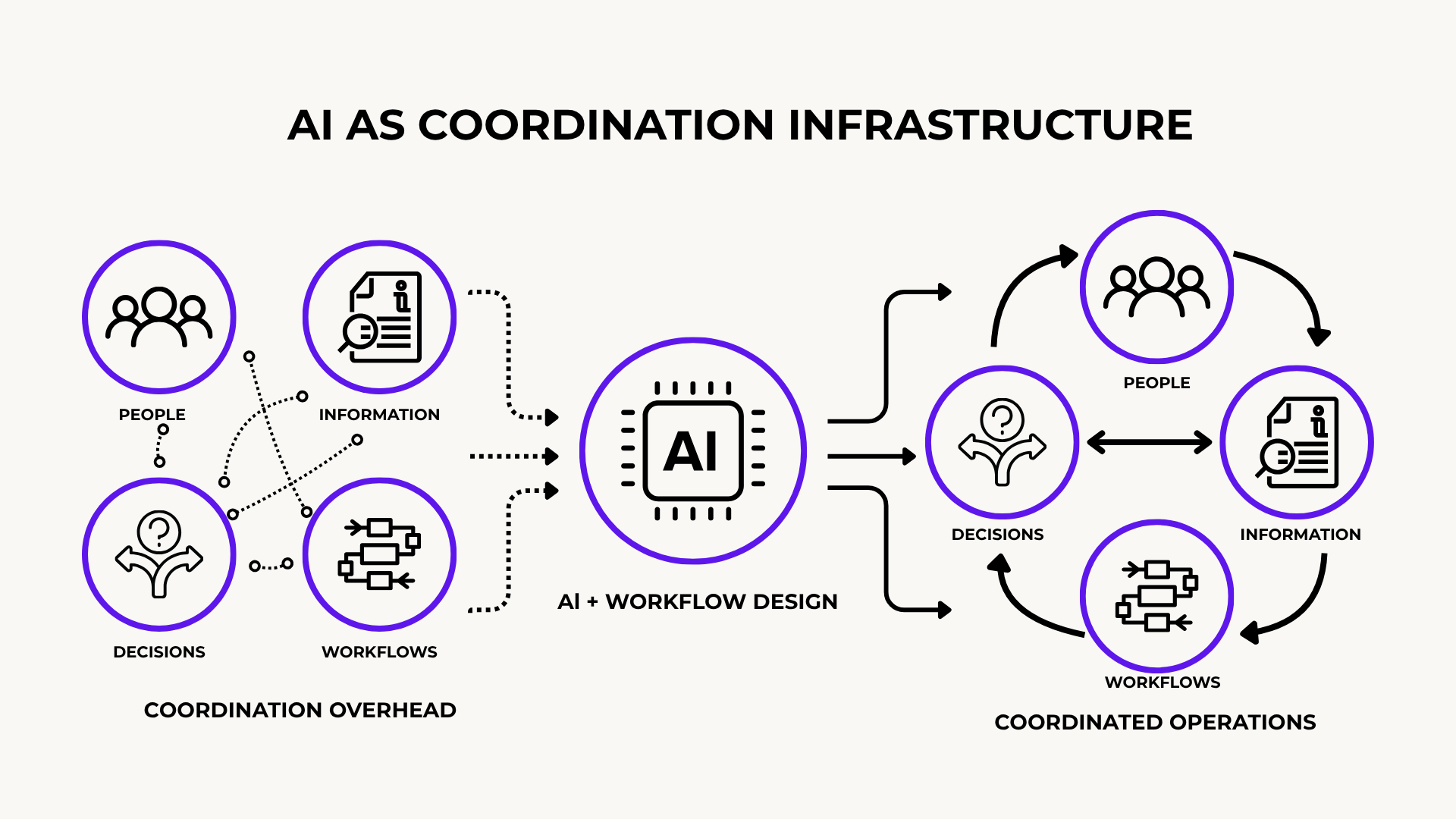
Most of the conversation about AI in organisations focuses on content generation: producing text, summaries, reports, and communications faster than before. That is a real capability. But in most operational environments, it is not where AI delivers its most durable return.
The larger opportunity is coordination. In community and organisational contexts, a significant proportion of working time is consumed not by substantive work but by the activities surrounding it: checking who has what information, confirming messages that have been received, following up on outstanding actions, routing decisions to the right people, and reconciling what one system says with what another shows. This coordination overhead is pervasive and largely invisible, precisely because it is woven into ordinary working days rather than appearing as a distinct category of work.
The real benefit of a unified community operation is efficiency. It is the cognitive load carried by the people trying to hold it together.
AI, when designed as coordination infrastructure, directly addresses this issue. A well-designed automated sequence does not just send messages; it tracks responses, flags unanswered communications, updates records, and triggers the next action without requiring a person to hold the state of the entire process in their head. An AI-assisted event coordination system does not just draft invitations; it maintains participant lists, manages confirmations, flags conflicts, and surfaces the decisions that genuinely require human attention. The content it produces is almost incidental to the coordination it enables.
Organisations that evaluate AI primarily based on its content output are measuring the least interesting parts of its value. The more significant question is how much coordination overhead has been reduced. How many handoffs now happen without manual intervention? How much of the working memory has been freed from tracking process state and redirected to the work itself?
In community operations specifically, the coordination problem is visible at scale. Tracking who has been contacted, what they were told, what they responded to, and what needs to happen next across hundreds of interactions running in parallel is genuinely difficult without systems designed for it. AI positioned as coordination infrastructure addresses this issue at the root: not by making individual interactions faster, but by reducing the overhead of managing the space between them.
The practical implication is a different starting question. Instead of asking what AI can generate, the more useful question is, where does coordination overhead create friction, errors, or unnecessary load on the people doing the work? That question usually points to where AI investment will produce meaningful return.
What Organisations Get Wrong About AI Adoption
 The most persistent assumption is that implementation is primarily a technical challenge. The technical components connecting systems, designing prompts, and configuring automation are usually the most tractable parts of the work. The challenging parts are operational: getting teams to change how they work, maintaining quality as complexity grows, and building the patience required for iterative improvement rather than immediate results.
A related mistake is treating AI adoption as a project. Projects have completion dates. Capabilities require sustained investment in design and improvement. An AI-assisted workflow left unmanaged after deployment will degrade, not because the technology gets worse, but because the operational context around it changes and the system is not updated to reflect that.
Additionally, there is a lack of effective measurement. The number of automated messages sent is not an indicator of engagement quality. The volume of content generated is not an indicator of communication effectiveness. AI systems that optimise measurable activity without connecting it to outcomes generate impressive metrics, but they disappoint in practice. The measure that matters is whether the coordination overhead has reduced and whether the people doing the work have more capacity for the parts that require genuine human judgement.
Measuring AI success by output volume is like measuring a community by headcount. It provides some information, but it does not address the most important aspect.
Conclusion
The advantage from AI over the coming years will not come from access to tools. Most tools will be accessible to most organisations at roughly equivalent cost. The advantage will come from the quality of the operational infrastructure surrounding those tools: the workflow design, the prompt architecture, the integration quality, and the trust built with the people who need to use the systems every day.
That infrastructure is, at its core, coordination infrastructure. The most durable gains come from reducing the overhead that accumulates between tasks: the handoffs, the status checks, the decision routing, and the information reconciliation that consumes capacity without appearing in any output. Designing AI into the coordination layer rather than just the content layer changes what gets built, what gets measured, and where the value accrues.
The organisations doing this well are not necessarily the ones with the most sophisticated tools. They are the ones that have been most honest about what their operational environments actually look like and most deliberate about where AI needs to sit to make a real difference.
Responses